A Limited Overs International league structure with multiple divisions and sensible promotion/relegation
The 2023 men's ODI World Cup has reminded us that cricket has a capacity to grow beyond its traditional nations, especially through the establishment of a merit-based league structure that allowed the Dutch team to play regularly against Full Members outside of major tournaments. Their involvement in the ODI Super League gave the Netherlands team an opportunity to develop on and off the field, culminating in qualifying and now performing brilliantly at the World Cup. The fact is, if it wants to properly grow, international cricket needs more structures like the Super League, not less.
This post is a proposal of how a league structure could work to be inclusive and meritocratic while taking steps to compromise with some of the Full Member nations' priorities. The system works along the following guidelines:
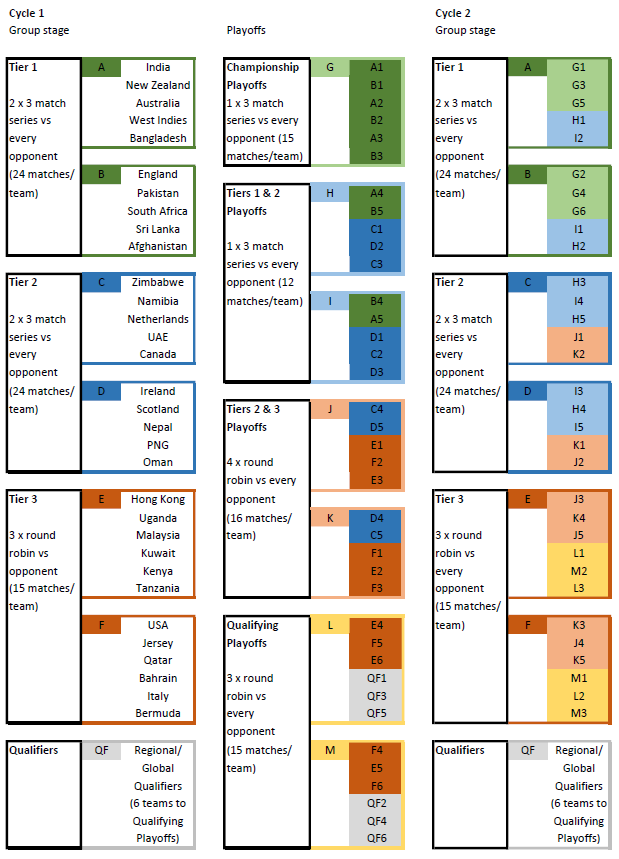
- Total of 32 teams spread into three tiers: 10 in Tier 1, 10 in Tier 2, 12 in Tier 3
- After the teams in each tier have played each other, the tiers are split
- Top 6 teams in Tier 1 progress to a Championship playoff to decide who wins the league; all 6 teams will be in Tier 1 for the next league cycle
- Bottom 4 teams from Tier 1 and Top 6 teams from Tier 2 progress to the Tiers 1 and 2 playoff; top 4 teams in this playoff will play in Tier 1 in the next cycle, while the bottom 6 will play in Tier 2
- Similarly, bottom 4 teams from Tier 2 and Top 6 teams from Tier 3 progress to the Tiers 2 and 3 playoff; top 4 teams in this playoff will play in Tier 2 in the next cycle, while the bottom 6 will play in Tier 3
- Bottom 6 teams in Tier 3 progress to a Qualifying playoff where they meet 6 teams who started the league cycle outside the league but qualified through regional pathways; top 6 teams in this playoff will play in Tier 3, while the bottom 6 will return to the regional pathways
There's multiple ways to schedule this, but I've decided to go with a UEFA Nations League-style system where teams in each tier are split up into groups, pictured below:
Benefits to this system:
- Top teams only want to play top teams - this league allows them to do so if they remain good enough
- Teams ranked 7-12 typically oppose promotion/relegation fearing that being relegated stops them from playing top teams - top Tier 2 teams can still play Tier 1 teams and have a pathway to qualify for Tier 1
- Teams ranked 13 and below typically have difficulty scheduling matches against higher ranked teams - top teams in every tier are given opportunities to play against teams in the tier above
- Promotion in this system only happens when teams show that they are good enough to consistently beat teams ranked above them (similarly, relegation only happens when teams are bad enough to consistently lose to teams ranked below them), but everyone gets a chance to move up
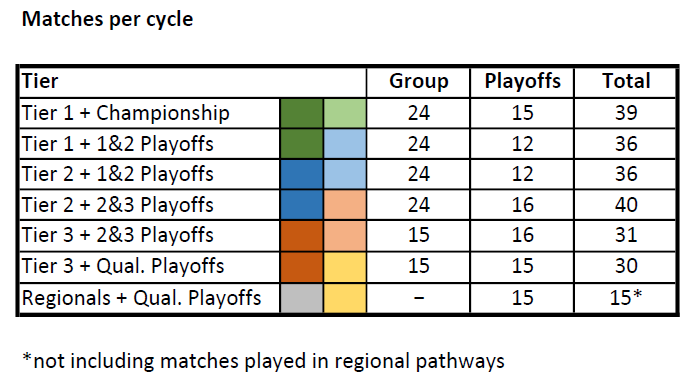
- If played in a 4 year World Cup cycle, Full Members would average out to less than 10 matches per year, leaving plenty of room for Tests and franchise leagues
- The league is not a closed shop as teams ranked below Tier 3 can qualify to be included in the next cycle
- The league can be connected to a World Cup qualifying system
The exact details, like how many tiers, how many teams per tier, how many matches each tier plays, whether the number of teams/divisions/matches should differ between the men's and women's games and between ODI and T20I, can be debated and adjusted. The overall point is that international cricket needs structures that can guarantee fixtures for more than just the traditional nations and can provide a pathway for them to, at least theoretically, reach the very top.